
DIOCESE—In preparation for the Jubilee Year 2025, Bishop David Malloy announced in a letter to priests and parishes of the diocese that he has designated seven parishes as pilgrimages sites.
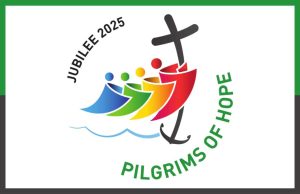
The year 2025 has been designated by the Holy Father Pope Francis as a Jubilee Year carrying the theme, “Pilgrims of Hope.” Characteristics of a jubilee year include pilgrimage, reconciliation and prayer. To accomplish this, the Holy Father has asked that dioceses identify parishes that will be a “gathering point for pilgrims.” In these churches various activities will take place, including sessions of catechesis in a variety of languages to help people rediscover the true meaning of the Holy Year. These churches will also offer pilgrims the chance to receive the sacrament of reconciliation and nurture their faith through prayer.
In the Diocese of Rockford, the following churches are being designated as pilgrimage sites for the Jubilee Year.
- Cathedral of St. Peter Parish, Rockford
- St. Mary Parish, Sterling
- St. Thomas Aquinas Parish, Freeport,
- St. Mary Parish, Huntley,
- Our Lady of Good Counsel Parish, Aurora,
- St. Thomas More Parish, Elgin and
- St. Mary Parish, DeKalb.
In his letter, Bishop Malloy announced that a solemn Mass will be celebrated to initiate the Jubilee Year in the Diocese on Dec. 29 at 11 a.m., at the Cathedral of St. Peter.
What exactly is a Jubilee Year and why is it important to people of faith?
According the Vatican Jubilee website, “Jubilee is the name given to a particular year; the name comes from the instrument used to mark its launch. In this case, the instrument in question is the yobel, the ram’s horn, used to proclaim the Day of Atonement (Yom Kippur). This (Jewish) holiday occurs every year, but it takes on special significance when it marks the beginning of a Jubilee year. We can find an early indication of it in the Bible: a Jubilee year was to be marked every 50 years, since this would be an ‘extra’ year, one which would happen every seven weeks of seven years, i.e., every 49 years (cf. Leviticus 25:8-13). Even though it wasn’t easy to organize, a Jubilee year was intended to be marked as a time to re-establish a proper relationship with God, with one another, and with all of creation, and involved the forgiveness of debts, the return of misappropriated land, and a fallow period for the fields.”
The site goes on to explain that “In 1300, Pope Boniface VIII called the first Jubilee, also known as a ‘Holy Year,’ since it is a time in which God’s holiness transforms us. The frequency of Holy Years has changed over time: at first, they were celebrated every 100 years; later, in 1343 Pope Clement VI reduced the gap between Jubilees to every 50 years, and in 1470 Pope Paul II made it every 25 years. There have also been ‘extraordinary’ Holy Years: for example, in 1933 Pope Pius XI chose to commemorate the 1900th anniversary of the Redemption, and in 2015 Pope Francis proclaimed the Year of Mercy as an extraordinary jubilee. The way in which Jubilee Years are marked has also changed through the centuries: originally the Holy Year consisted of a pilgrimage to the Roman Basilicas of St. Peter and St. Paul, later other signs were added, such as the Holy Door. By participating in the Holy Year, one is granted a plenary indulgence.”
To find out more about the jubilee year visit https://www.iubilaeum2025.va/en.html
THE JUBILEE 2025 PRAYER
|
|